
Licensed · Veteran-Owned · Master Plumber MP211014
Gas Water Heater Installation & Replacement in Lilburn, GA
No hot water, a tank leaking across the garage floor, rusty water from the hot tap, or a pilot that won't stay lit on a unit past its tenth year - a failing gas water heater rarely gives much warning. Stars and Pipes Plumbing Atlanta installs and replaces gas tank and tankless water heaters across Gwinnett County, permitted and built to Georgia code. Veteran-owned, master-licensed (MP211014).
- MP211014GA Master Plumber
- Veteran-OwnedFamily-operated since 2024
- 5.0★200+ reviews
- Same-Day24/7 emergency service
Signs it's time to replace a gas water heater
No hot water and a pilot that won't stay lit
A failed thermocouple or gas control valve on an older unit. We'll tell you honestly whether it's a repair or a replacement.
Hot water runs out fast or never gets hot
A sediment-packed tank, a failing dip tube, or a unit that's simply undersized for the household.
Water pooling under the tank
A corroded tank leaking through usually means replacement - but we confirm it isn't just a valve or fitting first.
Rusty or metallic-smelling hot water
A spent anode rod and a corroding tank, common once a unit passes 10–12 years.
Rumbling, popping, or banging when the burner fires
Hardened sediment overheating on the tank floor, which shortens whatever life the unit has left.
The unit is 10+ years old
Gas tanks typically last 10–15 years. Past that, replacing on your schedule beats a flooded floor on the heater's.
Rust or scorching around the burner or gas valve
A combustion or venting problem that makes replacement the safe call rather than a patch.
Missing or wrong code items
No expansion tank, an undersized gas line, or improper venting - which we correct as part of a proper install.
Rated 5.0 by Local Homeowners
What our customers say
Repair or replace?
A newer gas water heater with one failed part is usually worth repairing. Once the tank is corroding or the unit is past its expected life, replacement is the better long-term value.
Repair usually makes sense when…
- The unit is under about 8–10 years old
- A single part failed - thermocouple, gas valve, or T&P valve
- The tank itself is dry and sound
- Repair cost is well under the price of a new unit
Lean toward replacement when…
- The tank is 10+ years old
- It's leaking from the tank, not just a fitting
- You've had repeated repairs in a short span
- You want to move up to tankless or a larger capacity
What to expect
- An honest sizing and repair-or-replace assessment - the right tank capacity or tankless BTU load for your household, not an upsell
- We pull the Gwinnett County permit and install to Georgia code so the unit stays insurable
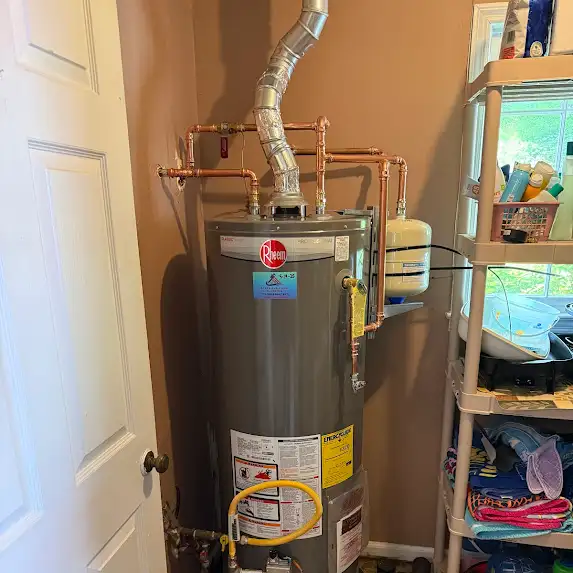
- The new unit set with a fresh T&P relief valve, gas flex connector, sediment trap, and shutoff
- An expansion tank added where the home is on a closed system (required on most Metro Atlanta municipal supply)
- Correct venting and combustion air, plus a drain pan and line where the unit sits in a finished space or attic
- Old unit hauled away, the install leak-tested, and the inspection coordinated
What it costs: You get an upfront, flat price that covers the unit, the code upgrades, the permit, and haul-away - no à la carte surprises when the installer arrives. Tankless and gas-line upsizing cost more up front, but you see the full number before we start.
Call 770-398-STARBrands & parts we service
Brands
- Rheem
- A. O. Smith
- Bradford White
- Rinnai
- Navien
- Bosch
- State
Common parts we replace
- gas control valves
- thermocouples
- T&P relief valves
- thermal expansion tanks
- gas flex connectors
- sediment traps (drip legs)
- anode rods
- venting & flue components
Frequently asked questions
Do I need a permit to replace a gas water heater in Gwinnett County?
Yes. A full gas water heater replacement requires a permit and inspection in Gwinnett and across Metro Atlanta. We pull it, install to Georgia code, and coordinate the inspection so the unit stays insurable and the utility keeps service on.
Tank or tankless - which is right for my home?
Tankless gas units deliver endless hot water and last longer (20+ years vs 10–15 for a tank), but they cost more up front and often need the gas line upsized and dedicated venting. A tank is cheaper to install and simpler to service. We size both to your household and lay out the trade-offs.
Why does a gas water heater install cost what it does?
The unit is only part of it. Georgia code requires items many older installs skipped - an expansion tank, proper venting and combustion air, a sediment trap, a new T&P valve, and a pan where needed - plus the permit. Tankless adds gas-line and venting work. You get the full flat price before we start.
Do I need an expansion tank?
On most Metro Atlanta homes, yes. Municipal supply with a backflow preventer or pressure regulator creates a closed system, and Georgia code requires a thermal expansion tank so pressure doesn't build and dump through the T&P valve. We add one when your system calls for it.
Does a tankless water heater need a bigger gas line?
Often, yes. Tankless units fire at a far higher BTU load than a tank, so the ¾-inch line that fed the old heater may need upsizing to run the tankless correctly. We calculate the load and upsize the line as part of the install.
Are you licensed to do gas water heater work?
Yes - the gas and water connections are both licensed work, done by a Georgia Master Plumber (license MP211014). The same licensed plumber handles the fuel side, the venting, and the code inspection, not a subcontracted crew.
How long does a replacement take?
A straight tank-for-tank swap is usually a few hours. A tankless conversion, or a job that needs gas-line upsizing or new venting, takes longer - often most of a day - because there's more to do to bring it to code. We give you a realistic window when we quote it.
How long does a gas water heater last?
A gas tank typically runs 10–15 years, a tankless 20 or more with annual descaling. Sediment settling in the bottom of the tank shortens that life either way, so once yours is past ten and showing rust or noise, planning the replacement beats an emergency one.
Gas water heater installs across Gwinnett County
Replacement calls come from every era of home we cover - postwar ranches around Tucker, Decatur, and Norcross where an atmospheric tank vents up an old chimney, century-old houses near the Marietta Square with the same arrangement, slab homes in Snellville and Lawrenceville tight on closet space, and newer two-stories toward Suwanee and Buford where homeowners want to move up to tankless. We size the unit to the house, wherever you are across the Gwinnett County and Metro Atlanta area we serve.
A gas water heater is really two trades in one - the water side and the fuel side. When a tankless upgrade needs the gas line upsized or a new run brought over, that’s part of the gas line and appliance work we’re licensed for, so the heater and its fuel supply are handled correctly in a single permitted job - the same in a Loganville subdivision as in a Peachtree Corners two-story.
Where we work
Cities we serve across Metro Atlanta
- Lawrenceville
- Lilburn
- Tucker
- Snellville
- Dunwoody
- Doraville
- Johns Creek
- Suwanee
- Norcross
- Buford
- Loganville
- Duluth
- Grayson
- Decatur
- Stone Mountain
- Cumming
- Buckhead
- Peachtree Corners
- Sandy Springs
- Alpharetta
- Roswell
- Marietta
- Brookhaven
Need gas water heater installation & replacement today?
Talk to a licensed plumber now - upfront pricing, no surprises.