
Licensed · Veteran-Owned · Master Plumber MP211014
Whole-House Water Filtration Systems in Lilburn, GA
Water that smells like a swimming pool at every tap, grit in the aerators after the county works on a main, or a well that leaves an orange ring in the tub - those are treatment problems, and a pitcher on the counter won't touch them. Stars and Pipes Plumbing Atlanta installs point-of-entry filtration and softening at the main line across Gwinnett County, sized to your water and permitted to Georgia code. Veteran-owned, master-licensed (MP211014).
- MP211014GA Master Plumber
- Veteran-OwnedFamily-operated since 2024
- 5.0★200+ reviews
- Same-Day24/7 emergency service
Water problems a whole-house system fixes
Chlorine or "swimming pool" smell at every tap
The chlorine and chloramine Metro Atlanta utilities use to disinfect the supply - it's doing its job in the mains, but it follows the water into your shower.
Grit or cloudy water after a water main break
Sediment and rust stirred out of aging distribution pipe, ending up in your aerators, toilet tanks, and washing machine screens.
Orange or brown staining in tubs and laundry
Dissolved iron - common on private wells in the outlying counties, and on homes still fed by old galvanized pipe.
Rotten-egg smell, worst on the hot side
Hydrogen sulfide gas, almost always a well-water problem and sometimes generated inside the water heater itself.
White crust on showerheads and heating elements
Genuine hard water - rare on Gwinnett County and City of Atlanta supply, but routine on private wells north of the metro.
Soap won't lather and glassware comes out spotted
Hardness minerals binding with detergent instead of cleaning, leaving film on dishes and residue on skin and hair.
Pressure falls off after a filter was installed
An undersized housing or a cartridge nobody has changed - a correctly sized system shouldn't cost you noticeable pressure.
Water heater rumbling and dying young
Scale baking onto the elements and collecting in the tank bottom, which drives up the gas bill and shortens the heater's life.
Rated 5.0 by Local Homeowners
What our customers say
Do you need filtration, softening, or both?
This is the question most Metro Atlanta homeowners get sold wrong. Gwinnett County, City of Atlanta, and DeKalb water is genuinely soft - roughly 1–3 grains per gallon - so a softener usually solves a problem you don't have. On city water the real complaints are chlorine, taste and odor, disinfection byproducts, and sediment, and that's carbon's job. Softening earns its keep on well water, where hardness routinely runs 7–15+ grains.
Carbon filtration is usually enough when…
- You're on Gwinnett County DWR, Atlanta, DeKalb, or Lawrenceville city water
- The complaint is chlorine taste, odor, or chemical smell
- You want disinfection byproducts and many PFAS compounds reduced
- Sediment shows up after main breaks or utility work
Add softening when…
- The home is on a private well
- A hardness test comes back above about 7 grains per gallon
- Scale is visibly crusting fixtures and water heater elements
- Iron staining or a sulfur smell needs dedicated media, not just carbon
Want it purified for drinking, not just filtered? That's reverse osmosis and drinking-water purification.
What to expect
- We test your water first - hardness, chlorine, iron, sediment, TDS - so the system is specified against your actual numbers, not a sales script
- Size the equipment to the home's real flow rate and fixture count, because an undersized tank is what causes the pressure complaints people blame on filtration
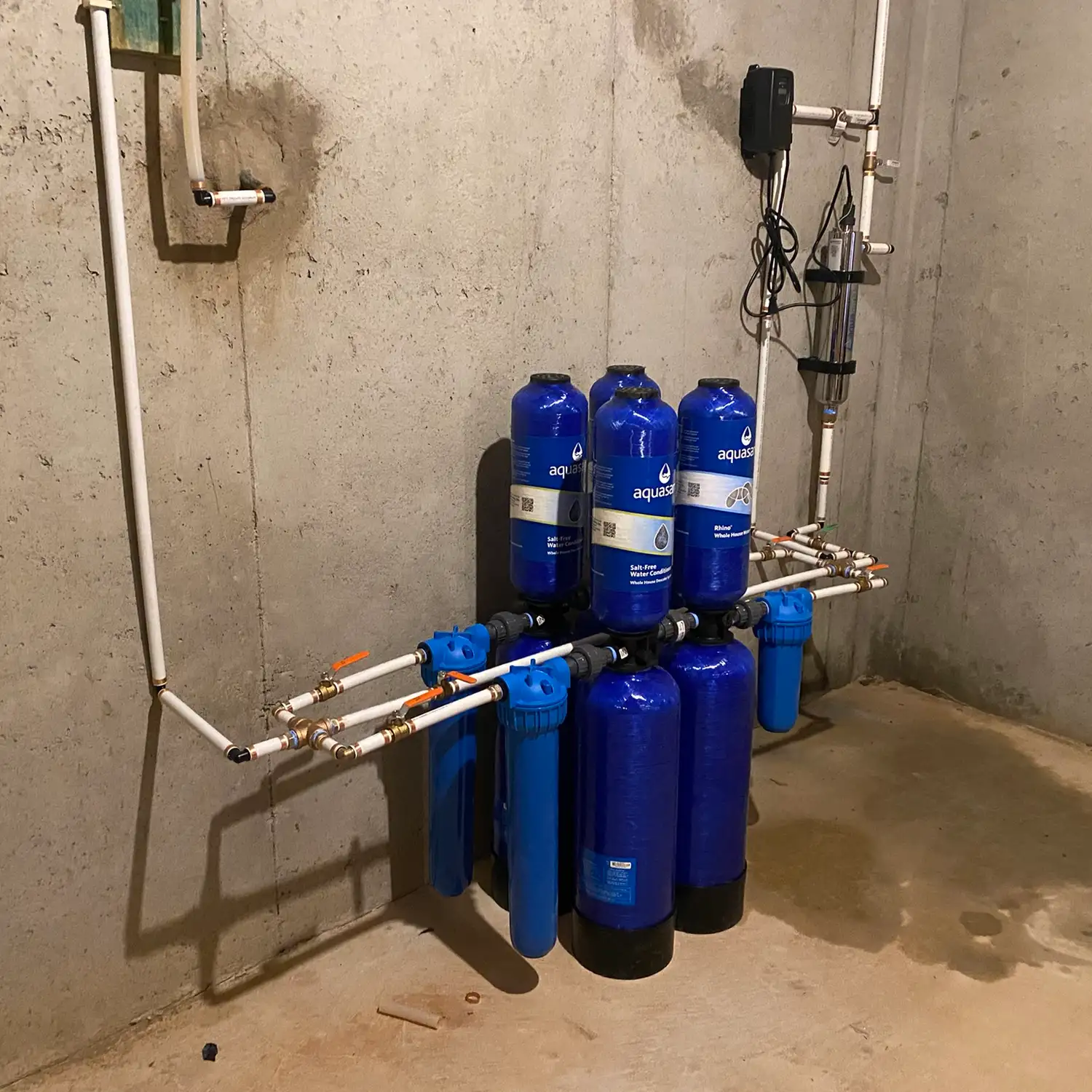
- Install at the main line just past the meter and ahead of the water heater, with a three-valve bypass loop so the system can be serviced without shutting off the house
- Pull the permit and set the code-required backflow protection and air-gapped drain line, then start up, backwash, and pressure-test before we leave
What it costs: Most whole-house installs in Metro Atlanta land between $1,200 and $3,500 for a carbon tank, or $2,500–$5,000 for a softener-and-carbon combination on well water - equipment, permit, and labor together. A simple sediment-and-carbon cartridge setup runs less. You get one upfront price after the water test, not an estimate that moves once we're under the house.
Call 770-398-STARBrands & parts we service
Brands
- SpringWell
- Pentair
- Aquasana
- 3M Aqua-Pure
- Culligan
- Kinetico
- Halo
Common parts we replace
- sediment pre-filter & spin-down
- catalytic carbon media tank
- KDF copper-zinc media
- softener resin & brine tank
- metered control valve head
- three-valve bypass loop
- air-gapped drain line
- backflow check valve
- inlet & outlet pressure gauges
Frequently asked questions
Is Atlanta water hard? Do I actually need a water softener?
Probably not, if you're on city water - and that's the honest answer most water-treatment companies won't give you. Gwinnett County, City of Atlanta, and DeKalb supply is soft to slightly hard, generally around 1–3 grains per gallon, which isn't enough to scale up your fixtures. Softeners make sense on private wells in the outlying counties, where hardness commonly runs 7–15+ grains. We test before we quote, and if your water doesn't need softening we'll tell you so.
What does a whole-house water filtration system cost installed?
A whole-house carbon tank typically runs $1,200–$3,500 installed for a two-to-four-bath home, while a combined softener and carbon system for well water generally falls between $2,500 and $5,000. A basic sediment-and-carbon cartridge setup is less. Labor is usually a half day, and the price we give you after the water test includes the equipment, the permit, and the install.
Where does a whole-house filter get installed?
At the main line, right after the water enters the house and before it branches - critically, ahead of the water heater, so both your hot and cold water are treated. It needs enough clearance for tank service, and softeners and backwashing filters also need a drain and a nearby outlet. In most Gwinnett County homes that's the garage, basement, or a crawlspace wall near the meter side of the house.
Will a whole-house filter hurt my water pressure?
It shouldn't. A system sized to your home's actual flow rate and plumbed with full-diameter ports has minimal effect on the pressure you feel at a fixture. When people do notice a drop, it's almost always a cartridge that's overdue for changing or a unit that was undersized for the house to hit a lower price. Sizing correctly up front is the whole fix.
Does a whole-house system need a permit in Gwinnett County?
Usually yes. Georgia moved to the 2024 International Plumbing Code as of January 1, 2026, and cutting into the main to add treatment equipment is permitted plumbing work in most Metro Atlanta jurisdictions. The code also requires backflow protection on the equipment and an air gap where the drain line ties into your DWV system. We pull the permit and handle the inspection - that paperwork is also what keeps the install clean at resale.
How often do the filters and media need changing?
Sediment cartridges usually go every three to six months, and carbon cartridges every six to twelve, depending on your water and how much you use. Tank media is a different story - a carbon bed typically lasts five to ten years before it needs rebedding, and softener resin often runs ten to fifteen. If you have a softener, plan on adding salt to the brine tank every month or two.
Does a whole-house filter remove PFAS and disinfection byproducts?
A quality carbon system reduces both meaningfully. Chlorine and chloramine react with organic matter in the supply to form disinfection byproducts like TTHMs and HAA5, and activated carbon is the standard treatment for them, along with many PFAS compounds. We specify equipment tested to NSF/ANSI 42 for chlorine, taste, and odor and NSF/ANSI 53 for health contaminants like lead. For the lowest possible levels at the tap you drink from, carbon at the main paired with reverse osmosis at the kitchen sink is the stronger setup.
What about salt-free "water conditioners"?
A salt-free conditioner doesn't actually remove hardness - it changes how the minerals crystallize so they're less likely to stick as scale. That's a reasonable trade on mildly hard water, and it needs no salt, no drain, and no regeneration cycle. On a genuinely hard well at 10+ grains, though, only a true ion-exchange softener will bring the hardness number down. Which one we recommend comes out of the water test.
What’s actually in Metro Atlanta tap water
The water Gwinnett County Water Resources, the City of Atlanta, DeKalb County, and Lawrenceville’s own utility deliver is treated, tested, and safe - and it still arrives disinfected with chlorine or chloramine, which is exactly what you’re smelling in the shower. It’s also soft, which is why the softener that made sense at a previous house in the Midwest is usually the wrong purchase here. Sediment is the other recurring complaint: when a main gets worked on or breaks, whatever was sitting in that aging pipe ends up in your aerators - a recurring complaint on the older mains around Norcross and in the Peachtree Corners subdivisions.
Wells are a different animal entirely. Homes on private wells in the counties ringing the metro deal with real hardness, iron staining, and the sulfur smell that comes from hydrogen sulfide, and those need dedicated media rather than a carbon cartridge. Well or city, the fix starts with a test - guessing at treatment equipment is how homeowners end up with a $4,000 system that solved nothing.
Filtration also quietly protects the rest of the system: scale and grit are hard on heaters, valves, and cartridges, and they shorten the life of components that show up in plenty of the repairs we get called out to make. We install and service point-of-entry systems throughout the Gwinnett County communities and Metro Atlanta suburbs we cover, North Fulton included - Roswell and Sandy Springs among them.
Where we work
Cities we serve across Metro Atlanta
- Lawrenceville
- Lilburn
- Tucker
- Snellville
- Dunwoody
- Doraville
- Johns Creek
- Suwanee
- Norcross
- Buford
- Loganville
- Duluth
- Grayson
- Decatur
- Stone Mountain
- Cumming
- Buckhead
- Peachtree Corners
- Sandy Springs
- Alpharetta
- Roswell
- Marietta
- Brookhaven
Need whole-house water filtration today?
Talk to a licensed plumber now - upfront pricing, no surprises.